
Information Gain vs Keyword Optimisation: What Matters More in 2026?

Search engine optimisation in 2026 is no longer a mechanical exercise in placing keywords neatly into headings and paragraphs. The landscape has matured. Search engines, particularly Google, have become significantly better at understanding meaning, context and value. As a result, the central debate for content strategists today is not simply how well a page is optimised for keywords, but how much new value it actually contributes.
The question is no longer whether keyword optimisation matters. It does. The more important question is whether it is enough. Increasingly, the answer is no. Information gain — the amount of original, useful insight a page adds beyond what already exists — has become the decisive factor in competitive search results.
Understanding Keyword Optimisation in 2026
Keyword optimisation remains a foundational aspect of SEO. At its core, it involves aligning a page with the words and phrases people type into search engines. This includes incorporating primary and secondary keywords into titles, headings, URLs, meta descriptions and body content in a natural and structured manner.
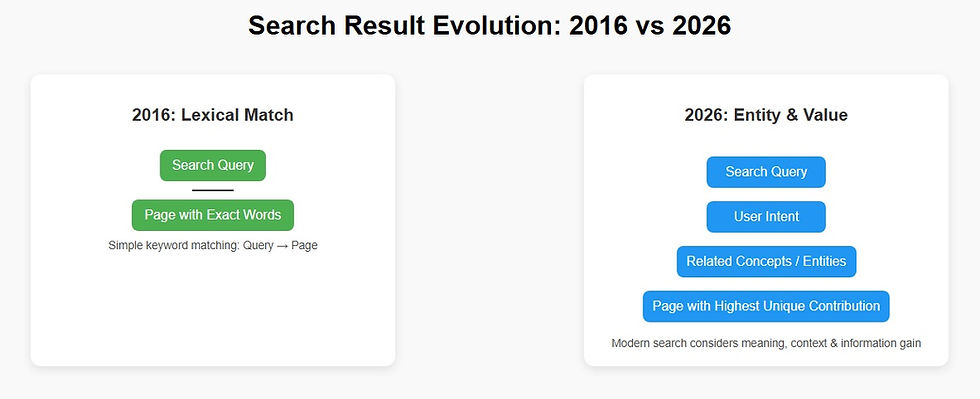
Historically, this approach worked remarkably well. Earlier search algorithms relied heavily on lexical matching. If a page contained the right words in the right places, it stood a strong chance of ranking. SEO professionals focused on keyword density, exact-match phrases and formulaic on-page structures because search engines lacked the contextual sophistication they possess today.
However, the environment has changed dramatically. Modern search systems interpret intent, analyse entities and understand relationships between topics. Simply inserting keywords no longer guarantees visibility, especially in saturated niches where dozens of pages are targeting the same query. In 2026, keyword optimisation ensures clarity and relevance, but it rarely provides differentiation.
Defining Information Gain
Information gain refers to the additional value a piece of content provides compared to what is already available in the search results. It measures the degree to which a page advances the conversation rather than merely repeating it.
If ten existing articles explain a concept in similar language with similar examples, an eleventh article that restates the same points offers little incremental value. In contrast, a piece that introduces original research, fresh data, practical case studies, or a genuinely new framework contributes meaningfully to the topic. That contribution is information gain.
In practical terms, information gain may stem from first-hand experience, proprietary data, detailed testing, interviews with subject matter experts or thoughtful analysis that synthesises ideas in a novel way. It aligns closely with principles such as experience, expertise and trust, because content that reflects real-world insight naturally tends to be more distinctive.
In an era where AI tools can generate competent but generic content in seconds, information gain has become the dividing line between adequate and exceptional.
How Search Algorithms Weigh Relevance and Contribution
Modern search algorithms operate on two essential layers. The first is relevance. A page must clearly match the user’s query and intent. Keyword optimisation plays a central role here. Without clear signals indicating what a page is about, even the most insightful content may struggle to surface.
The second layer is contribution. Once relevance is established, search systems evaluate which pages add the most value. This is where information gain becomes critical. Algorithms assess depth, comprehensiveness, freshness and the uniqueness of perspectives presented. They are increasingly adept at identifying redundancy across the web and prioritising pages that introduce something new.
In highly competitive results pages, most content is technically well optimised. Titles are polished, headings are structured and target phrases are present. When technical and keyword signals are comparable, the deciding factor becomes which page offers greater substance and differentiation.
Why Keyword Optimisation Alone Is No Longer Enough
The saturation of online content has intensified dramatically over the past few years. For nearly every commercial or informational query, there are thousands of pages competing for attention. Many of them are built using similar templates and tools. The structural optimisation across these pages often looks nearly identical.
This uniformity creates a new problem. When everyone is equally optimised, optimisation ceases to be a competitive advantage. It becomes the minimum requirement.
Moreover, the widespread use of generative AI has amplified duplication. While AI can efficiently incorporate keywords and produce coherent text, it tends to draw upon the same underlying pool of publicly available information. Without deliberate human intervention to introduce new ideas or experiences, much of this content lacks genuine novelty.
Search engines have responded by refining systems that detect low-value or repetitive content. Pages that do not expand the knowledge landscape struggle to achieve lasting visibility.
A Practical Illustration: Competing for “Best CRM Software”
Consider a competitive query such as “best CRM software”. A keyword-focused article might ensure that the target phrase appears in the title, headings and introductory paragraph. It may list popular platforms, summarise their features and include commonly cited pros and cons. Structurally, it may be flawless.
However, if it simply reiterates information already available across dozens of similar articles, it contributes little new insight.
By contrast, a content piece that conducts original usability testing, benchmarks performance metrics, evaluates pricing across different business sizes and provides a transparent scoring methodology introduces tangible information gain. Even if both articles are well optimised for the keyword, the latter offers a richer and more distinctive experience for the reader. In 2026, that distinction increasingly influences rankings and long-term stability.
When Keyword Optimisation Still Carries Weight
Despite the growing importance of information gain, keyword optimisation remains indispensable. For new websites with limited authority, clear keyword targeting helps search engines understand thematic focus. For product, category and local pages, precise optimisation ensures alignment with commercial intent.
Without a solid keyword foundation, a page may fail to signal its relevance effectively. In this sense, keyword optimisation functions as the entry requirement for participation in search results. It establishes clarity and ensures discoverability.
However, it should not be mistaken for a strategy in its own right. It is infrastructure, not differentiation.
When Information Gain Becomes the Decisive Factor
Information gain becomes particularly influential in competitive informational queries and mature industries such as finance, health, marketing and software. In these environments, most top-ranking pages are technically sound and well structured. The marginal gains that separate one result from another often stem from depth, originality and authority.
Content that introduces new research, synthesises complex ideas clearly or presents authentic experience stands a greater chance of earning backlinks, user engagement and sustained rankings. Over time, these signals reinforce one another, creating a compounding advantage.
Information gain also plays a crucial role in thought leadership. Brands that consistently publish original insights are more likely to be cited, referenced and remembered. This broader authority can indirectly strengthen overall search performance.
The Hybrid Approach That Wins in 2026
The most effective SEO strategies in 2026 integrate both keyword optimisation and information gain rather than treating them as opposing philosophies.
The process typically begins with careful keyword research and intent mapping to ensure alignment with user queries. From there, analysing the existing search results reveals gaps, weaknesses or outdated information. These gaps create opportunities to add meaningful value.

The final step involves layering in unique elements such as proprietary data, detailed examples, frameworks or experiential insight, while maintaining natural language and clear structure. The objective is to ensure the page is both easily understood by search engines and genuinely useful to readers.
This balanced approach recognises that optimisation enables visibility, but originality drives competitive success.
The Role of AI in Shaping the Debate
Artificial intelligence has reshaped content production workflows. It excels at structuring articles, summarising topics and incorporating keywords efficiently. Yet its strength in efficiency can also be its weakness in originality. Without unique inputs, AI-generated content often mirrors what already exists.
In 2026, the strategic advantage lies in combining AI’s efficiency with human expertise. AI can handle structural optimisation and drafting support, while human contributors introduce nuanced interpretation, lived experience and novel analysis. This collaboration enhances information gain while preserving keyword relevance.
Measuring Success Beyond Rankings
As search evolves, performance indicators extend beyond simple keyword positions. Engagement metrics such as time on page, repeat visits and backlink acquisition increasingly reflect whether content truly resonates. Pages that provide distinctive insight tend to earn organic references and maintain ranking stability even amid algorithm updates.
Keyword optimisation may secure initial placement, but information gain supports long-term durability.
In conclusion, Keyword optimisation remains essential in 2026. Without it, content risks invisibility. However, it is no longer the primary lever of competitive advantage.
Information gain has emerged as the more powerful differentiator. In crowded search results, the content that ranks sustainably is the content that adds something new, insightful or uniquely valuable.
The future of SEO does not belong to those who simply match queries. It belongs to those who meaningfully expand the answers.


Comments